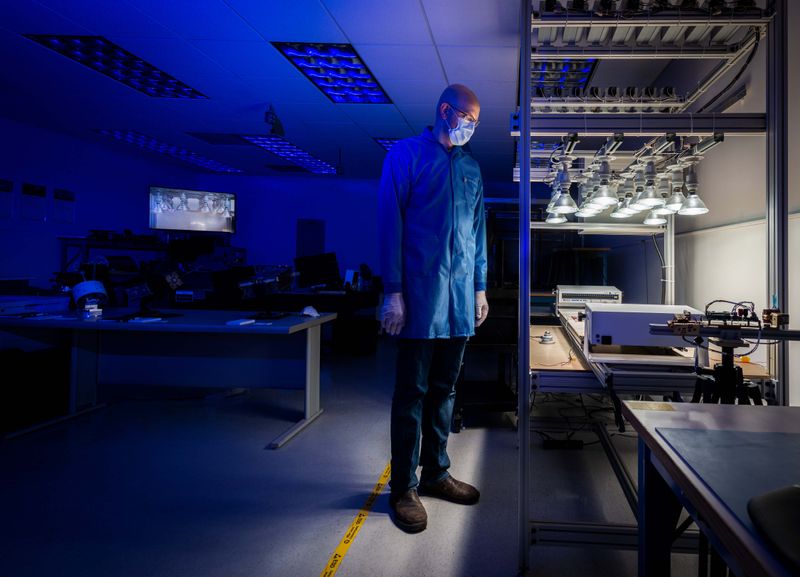
Explore some of the specialized tools and facilities SDL uses to build, test, and prepare technology for demanding missions. Credit: SDL | Allison Bills
At the Space Dynamics Laboratory (SDL), we bring the sun indoors, change the magnetic field around a satellite, measure contaminants by the microgram, and peer at hardware features smaller than a blood cell—all before we start simulating the space environment.
Behind the doors of our specialized facilities, engineers, scientists, and technicians use an array of specialized tools to solve technical problems and prepare technology for unforgiving destinations. Some tools span large, purpose-built facilities. Others could fit in a closet. Here are a few fascinating things you might not know happen at SDL.
We Have Our Own Sun
It’s not quite 93 million miles away, but it gets the job done. Our Small Satellite Avionics Service Center has a solar radiation simulator capable of recreating the intensity and spectral output of sunlight as seen from orbit.
Why bring the sun indoors? Solar arrays provide power for many spacecraft. The simulator allows experts to verify the output of mid-sized solar arrays under controlled conditions before they are expected to generate power in space.

We Look for Contaminants by the Microgram
What counts as contamination? It depends on what we are building. For many infrared sensors, materials that absorb infrared energy can interfere with instrument performance. This means that something as commonplace as silicone can become a concern when developing highly sensitive hardware.
In our Chemical Analysis Service Center, we use infrared spectroscopy to identify these materials and sensitive microbalances to quantify them down to the microgram—one millionth of a gram. The definition of “clean” becomes incredibly precise when preparing sophisticated technology for demanding environments. Something nearly imperceptible in everyday life can matter significantly when instrument performance depends on carefully controlled materials and surfaces.

We Can Change the Magnetic Field Around a Satellite
Satellites need to know which way to point, and testing the systems that control their orientation sometimes requires recreating the conditions they will encounter in space. Our closet-sized Helmholtz cage generates controlled magnetic fields around a satellite. Engineers use it to verify a spacecraft’s magnetometer readings and torque coils, which help control the spacecraft’s orientation.
Nearby, a floating rotational table allows teams to test torque wheels used for attitude control. Together, these tools help engineers verify how a spacecraft senses and controls its orientation, all without ever leaving the Lab.

We Can See Things Smaller Than a Blood Cell
Sometimes, solving a problem requires getting very, very close. A recently added digital microscope allows our specialists to examine hardware at the micrometer scale—smaller than a blood cell. It can automatically count particles and make three-dimensional measurements of extremely small defects, providing insight into contamination, corrosion, fabricated dimensions, and other microscopic characteristics that may affect hardware performance. When the details matter, we can get down to some remarkably small ones.

We Can Recreate Some of the Harshest Conditions of Space
Space combines vacuum with extreme temperatures—conditions that can dramatically affect materials, electronics, sensors, and other hardware. We operate thermal vacuum facilities that allow engineers to test hardware in simulated space environments. For NASA’s Near-Earth Object Surveyor (NEO Surveyor) mission, for example, we added a large thermal vacuum chamber capable of creating temperatures as low as –321°F.
NEO Surveyor will search for potentially hazardous asteroids and comets using infrared observations, and SDL is responsible for assembling, integrating, testing, and calibrating its infrared instrument. But before the instrument can study objects millions of miles away, it must first undergo testing inside a chamber in northern Utah.

Sometimes We Give Aluminum a Bath
Not every interesting capability requires an enormous chamber. Sometimes it requires a carefully controlled chemical bath. Our Chemical Analysis Service Center added a line of chromate conversion baths to bring a previously outsourced process in-house. The treatment applies a thin, durable, passive coating to aluminum to help improve its performance for spaceflight applications while meeting strict military specifications. The practice gives us greater control over a small but important part of preparing hardware for demanding environments.

Ready for What Comes Next
There isn’t one way to prepare technology for a demanding mission. Sometimes the challenge is measured in degrees. Other times, it’s measured in micrometers or micrograms. Our facilities provide different ways to investigate problems, verify performance, and understand how technology will behave when it matters. And as the technologies and missions that we support continue to evolve, so will the tools used to build, test, and prepare what comes next.
Explore our facilities and discover more of what’s possible at SDL.
