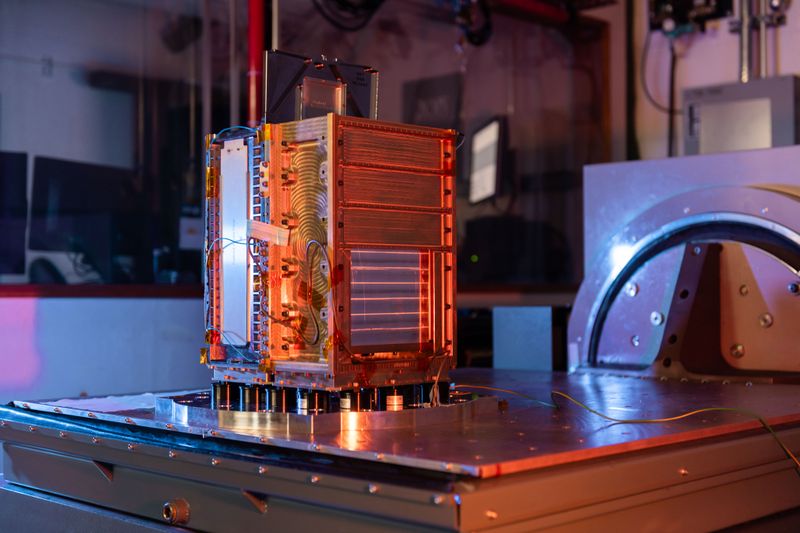
One of six SunRISE satellites undergoes vibration testing. Credit: SDL | Allison Bills
Utah State University’s Space Dynamics Laboratory has completed vibration testing of a fleet of six small satellites that will form NASA’s Sun Radio Interferometer Space Experiment (SunRISE). The successful completion of vibration testing is a critical milestone to ensure that the spacecraft are ready for the structural dynamics they will experience during launch and the harsh conditions of space.
NASA recently announced that it is targeting a launch later this year for its heliophysics mission as a rideshare aboard a United Launch Alliance Vulcan Centaur rocket, sponsored by the United States Space Force’s Space Systems Command.
The mission’s primary objective is to study solar radio bursts and their impact on space weather. SDL ensured that the sensitive scientific payloads were properly integrated into the spacecraft and would function as intended in orbit. The laboratory worked closely with NASA’s Jet Propulsion Laboratory in Southern California, which manages the SunRISE mission, to verify that the satellites met all mission requirements. This included functional validation of the satellites’ communication systems, power systems, and overall design.
Vibration testing is a crucial milestone in the development of any satellite mission. During launch, satellites are subjected to intense mechanical vibrations and acoustic loads generated by the rocket's engines and aerodynamic forces. These conditions can impose stress on the satellite's components. Vibration testing simulates these launch conditions on Earth to ensure that the satellite can withstand the mechanical stresses it encounters during liftoff.
“For the SunRISE mission, vibration testing was particularly important because the mission involves a constellation of six individual small satellites. When launched together, it’s critical that all six operate reliably so that together they can make these science measurements of the Sun,” said Tim Neilsen, SDL’s civil space branch head for spacecraft missions and technologies, and the lab’s SunRISE program manager. The testing process validated the structural integrity of the SDL-built satellites as well as the robustness of the spacecraft and its components.
In addition to assembly, integration, and vibration testing, SDL conducted a series of comprehensive tests to simulate the satellites' space environment. These tests included thermal vacuum testing, which simulated the extreme temperature fluctuations in orbit, and electromagnetic compatibility testing, which ensured that the satellites’ systems would not interfere with the sensitive payload.
Once on orbit, the six SunRISE satellites will work together as a virtual radio telescope to study solar activity. By observing low-frequency radio emissions from the Sun, the mission will provide valuable insights into the mechanisms that drive solar storms and their impact on Earth's space environment. This information will be crucial for enhancing space weather forecasting and safeguarding satellites, astronauts, and ground-based infrastructure from the effects of solar activity. The SunRISE science investigation is led by the University of Michigan in Ann Arbor, which also provides the mission’s science operations center .
“Under the leadership of NASA’s Jet Propulsion Laboratory , the successful completion of vibration tests at SDL brings the SunRISE satellites one step closer to their targeted launch in the summer of 2026,” Neilsen said.
Headquartered on Utah State University’s Innovation Campus in North Logan, UT, SDL is an independent nonprofit corporation owned by USU. It employs 1,400 engineers, scientists, technicians, and business professionals who solve technical challenges faced by the military, science community, and industry and support NASA’s vision to explore the secrets of the universe for the benefit of all. SDL has field offices in Albuquerque, NM; Chantilly, VA; Huntsville, AL; Ogden, UT; and Stafford, VA.
As one of 15 Department of Defense University Affiliated Research Centers, SDL is both a trusted advisor to the U.S. government and a specialist in its areas of expertise, rapidly developing government-owned solutions to nationally significant challenges.
Contact
- SDL Public Relations
- 435-713-3054
- pr@sdl.usu.edu