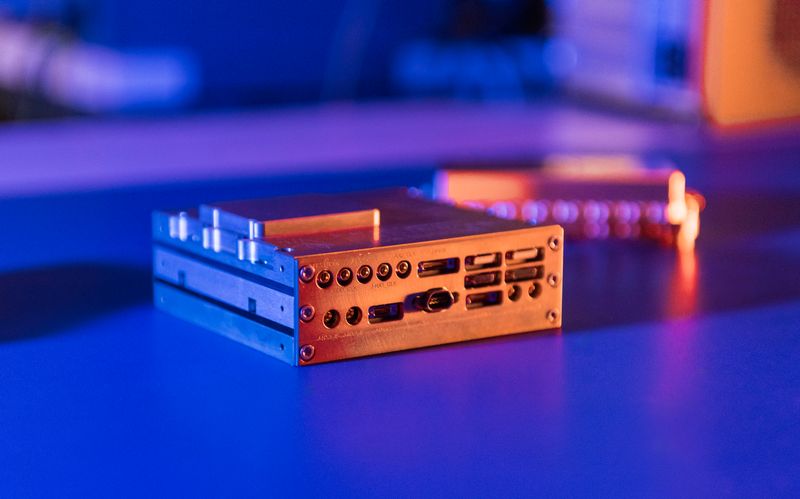
SDL is providing the deep space telecommunications radio system for NASA's CAPSTONE 02 mission, enabling new capabilities for autonomous operations in a lunar orbit. Credit: SDL | Prabhjot Bhatia
NORTH LOGAN, Sep. 22, 2026 — Utah State University’s Space Dynamics Laboratory announced at the 40th Annual Small Satellite Conference that it has been selected by Advanced Space LLC to provide deep space communications and time-keeping technology for NASA’s CAPSTONE 02 mission. This technology demonstration will further develop autonomous navigation, spacecraft-to-spacecraft communications and proximity operations around the Moon in support of NASA’s Artemis and Moon Base programs.
Building on the success of the original CAPSTONE mission, launched in 2022, SDL will design, manufacture and test two flight-qualified Iris Radios and associated communication, navigation and precise time-keeping hardware for CAPSTONE 02’s twin 400-kilogram small satellites. SDL’s radios will provide direct-to-Earth connectivity as well as an additional spacecraft-to-spacecraft link, enabling the spacecraft to communicate directly with one another. This will enable new capabilities for autonomous operations in a lunar orbit.
CAPSTONE 02 expands on technologies first demonstrated during the original CAPSTONE mission, which successfully validated a near-rectilinear halo orbit, a fuel-efficient path around the Moon that repeatedly brings a spacecraft close to the lunar surface before carrying it thousands of kilometers away, making it ideal for future lunar exploration missions. It also demonstrated Advanced Space’s Cislunar Autonomous Positioning System, or CAPS, navigation software.
CAPSTONE 02 will use two spacecraft operating in cislunar space, the region between Earth and the Moon, to demonstrate autonomous rendezvous and proximity operation, spacecraft-to-spacecraft communications and advanced navigation techniques that reduce reliance on continuous tracking from Earth.
“CAPSTONE was a true path-finding mission that proved small satellites can accomplish big objectives beyond Earth’s orbit in lunar space. The Iris Radio on CAPSTONE continues to provide the reliable communications link and precision navigation and time-keeping capabilities that enabled mission controllers to reliably command and control the spacecraft and relay critical data throughout the mission. CAPSTONE successfully validated capabilities and built critical infrastructure that are helping shape humanity’s return to the Moon,” said Tim Neilsen, branch head of Spacecraft Missions and Technologies for Civil and Commercial Space at SDL. “SDL will help CAPSTONE 02 take the next step by advancing how spacecraft can communicate and coordinate with one another, navigate more autonomously and perform complex proximity operations around the Moon.”
SDL’s Iris Radio is a software-defined telecommunications spacecraft subsystem designed specifically for missions operating beyond low-Earth orbit. Developed from technology created at NASA’s Jet Propulsion Laboratory and transitioned to SDL for continued development and production, the radio is engineered to withstand the radiation and thermal extremes of deep space while providing continuous contact with NASA’s Deep Space Network.
The mission continues SDL’s long history of supporting NASA exploration beyond Earth’s orbit. In addition to supporting the original CAPSTONE mission, Iris Radios have flown on missions including MarCO, Lunar Flashlight, LICIACube, BioSentinel, LunaH-Map, NEA Scout, CuSP and ArgoMoon.
CAPSTONE 02 is targeted for launch in late 2027.
Headquartered at USU’s Innovation Campus in North Logan, UT, SDL is an independent nonprofit corporation owned by USU that solves technical challenges faced by the military, science community, and industry and supports NASA’s vision to explore the secrets of the universe for the benefit of all. SDL has field offices in Albuquerque, NM; Chantilly, VA; Colorado Springs, CO; Huntsville, AL; Ogden, UT; and Stafford, VA. For more information, visit sdl.usu.edu.
Contact
- Eric Warren
- Director, Public Relations
- Space Dynamics Laboratory
- 435-881-8439
- eric.warren@sdl.usu.edu